Tag Archives: Points of Interest

Maritime Burlington: New Waterfront Exhibit Highlights Burlington’s Nautical History

Maritime Burlington Comes to the Burlington Waterfront

June 20 brings a new attraction to the Burlington, Vermont waterfront.  Lake Champlain Maritime Museum (LCMM) features a new interpretive exhibit, Maritime Burlington in a festive “big top tent” at Perkins Pier on Maple Street.  The Maritime Burlington exhibit features highlights from the nautical archaeology fieldwork and historical research of LCMM. The exhibit encourages exploration and discovery and serves as a porthole to Burlington’s nautical history for visitors and area residents. It will also serve as a resource for LCMM’s new Lake Adventure Camps.


Maritime Burlington - Canal boats in port, Burlington, VT, early 1900s. Lake Champlain Maritime Museum Collection.

Canal boats in port, Burlington, VT, early 1900s.
Lake Champlain Maritime Museum Collection.

“We are very excited to be greeting the public right where so much history happened. The lake’s first steamboat, Vermont – and the second commercially successful steamboat in the world – was launched right here on the Burlington waterfront in 1808.” ~ LCMM Executive Director Mike Smiles


See the changing views of the Burlington waterfront over the years -the breakwater, lighthouses, steamboats, canal boats, railroads and the cargo shipped in and out of the Champlain Valley. Use a working replica of a nineteenth century crane to lift cargo into a small-scale canal boat. Weekends will feature demonstrations of such maritime skills as shaping spars, ropework and rigging.


Maritime Burlington - Looking south from Battery Street, Burlington, VT. Courtesy University of Vermont Bailey/Howe Special Collections.

Looking south from Battery Street, Burlington, VT.
Courtesy UVM Bailey/Howe Special Collections.

Several boats from the LCMM fleet will also visit the waterfront at Perkins Pier:

  • MV Baldwin will host the Saturday Shipwreck tours in July and August;
  • Champlain Longboats, the student-built rowing boats used for community rowing, regional racing events, and On Water Ecology tours.
  • Schooner Lois McClure  although the schooner is not available for boarding in 2015 while preparing for restoration work this fall
  • C. L. Churchill (the Lois McClure’s companion wooden tugboat)


Maritime Burlington Schedule

  •  June 20 through August 23: Open Daily
  • August 24 through October 12: Open Wednesday through Sunday
  • Lake Adventure Camps: June 22 through August 14


Acknowledgements

Lake Champlain Maritime Museum’s exhibit Maritime Burlington, 2015 Lake Adventure Camps and the restoration of schooner Lois McClure are made possible thanks to the generous support of sponsors including Burlington Parks, Recreation, and Waterfront, Lake Champlain Transportation, Seventh Generation, Merchants Bank, Dan Landau, the McClure Family, and the Lake Champlain Basin Program. This project was funded in part by an agreement awarded by the Great Lakes Fishery Commission to the New England Water Pollution Control Commission (NEI WPCC) in partnership with the Lake Champlain Basin Program (LCBP).


About the Lois McClure

Lois McClure was built by LCMM shipwrights and volunteers on the Burlington waterfront in 2001-2004, based on two shipwrecks of 1862-class canal schooners discovered in Lake Champlain.

Launched in 2004, Lois McClure has completed eleven journeys. Over 5,200 miles on the region’s inland waterways have carried the schooner south to New York City, west to Buffalo and Lake Ontario, and north to Quebec City, engaging people in history and archaeology at every port.

More than 220,000 visitors in 220 communities have stepped on board. This replica vessel has been the most effective outreach program LCMM has ever conducted, and is a leader in the world of Maritime Museums.


The Lake Champlain Maritime Museum

The Lake Champlain Maritime Museum is located on the shore of Lake Champlain at 4472 Basin Harbor Road in Vergennes, Vermont, across from the Basin Harbor Club. LCMM brings underwater discoveries and lake adventures to the public in exciting and imaginative ways.

The Museum is open daily from 10 a.m. to 5 p.m. through October 11, 2015. LCMM Members and children 5 and under receive free admission. For more information call (802) 475-2022 or visit www.lcmm.org.

Other Lake Champlain News:


Ed Weed Fish Culture Station Improvement to Improve Health of Lake Champlain Salmon

Ed Weed Fish Culture Station Improvement to Benefit Lake Champlain’s Salmon

The Vermont Fish & Wildlife Department expects that an upgrade at the Ed Weed Fish Culture Station in Grand Isle, Vermont will improve the health of the salmon population in Lake Champlain.


fish trap at the Ed Weed Fish Culture Station in Grand Isle.
Fish Culture Operations Chief Adam Miller with a landlocked Atlantic salmon
from the newly-installed fish trap at the Ed Weed Fish Culture Station in Grand Isle.


Vermont Fish & Wildlife Department hatchery staff, fisheries biologists and other officials recently joined forces to construct a fish trap on the station’s discharge stream, Hatchery Brook. The trap will help to improve the collection process for adult salmon when they return to the brook to spawn.

After collection, the adult salmon will be used to reproduce and provide fertilized eggs at the Ed Weed Fish Culture Station in Grand Isle, where the eggs will be hatched and the young salmon raised before their return to Lake Champlain.

“Being able to collect fish in a safe, efficient and effective way for both staff and salmon is key to our overall fisheries management plan. The improvements we’ve completed at the Ed Weed Fish Culture Station allow us to meet these objectives more effectively and ultimately produce healthy salmon for our Lake Champlain restoration efforts.” ~ Adam Miller, fish culture operations chief with Vermont Fish & Wildlife.

Former collection methods required more handling, put more stress on the fish, and were less efficient for hatchery staff and biologists.

“The new fish trap decreases the risk of injuries to adult salmon from handling and increases the health and condition of parent fish used to provide fertilized eggs to our hatchery system”. It should also decrease the stress on eggs taken from parent fish, which may improve egg survival rates in the hatchery.” ~ Chet MacKenzie, fisheries biologist with Vermont Fish & Wildlife.

The fish trap will also help fisheries biologists more efficiently collect data  from large numbers of returning salmon. The data collected will feature lamprey wounding rates, fish size, abundance and age structure – aiding the department’s assessment of salmon restoration efforts.

Ed Weed Fish Culture Station Improvement to benefit Lake Champlain Salmon

Landlocked Salmon, Salmo salar

The fish trap will also serve as an education tool. The public will be able to see fish when the trap is in operation, learn about salmon restoration efforts at the Ed Weed Fish Culture Station and in Lake Champlain, and learn about fish culture and the impacts of invasive species.

According to Vermont Fish & Wildlife Commissioner, Louis Porter, “We are always looking for ways to protect and improve the health and number of fish and other wildlife in the most efficient ways possible. These improvements in how we trap fish, so we can collect and fertilize salmon eggs were developed by hatchery staff and fisheries biologists, and their efforts to come together to put in place cost-effective solutions to improve our work will benefit the salmon population for years to come.”

To purchase a Vermont fishing license or to find out more about fishing opportunities in Vermont, visit www.vtfishandwildlife.com.


Other Lake Champlain Fishing Articles:


Island Line Trail: One of Top 5 Rail Trails in New England

Lake Champlain’s Island Line Trail: One of Top 5 Rail Trails in New England

Lake Champlain's Island Line Trail: One of Top 5 Great Rail Trails in New England

Lake Champlain’s Island Line Trail was featured as one of the five great paved rail trails in New England by the Boston Globe. The 14-mile trail hugs the eastern shore of Lake Champlain and offers views of the Adirondack Mountains rising across Lake Champlain on the New York side.

The Central Vermont Railroad built the line, with the first train arriving in Burlington in December 1849. Oakledge Park, the starting point on the southeastern side, is one of many spots along the trail where you’ll find small beaches and picnic areas. At Roundhouse Point, you’ll start to see the first of numerous sailboats tacking across the large lake. North Beach, at the trail’s midpoint mark, is a good place to picnic along the rocky shores. One of the best features of the Burlington Bike Path (a section of the trail) is that you’re always only a block or two away from a good deli.(Read the full article here)

Learn more about The Island Line at: www.islandlinetrail.org


Other Articles about Biking and Lake Champlain:


Fort Crown Point

1759, Essex County, Crown Point, New York

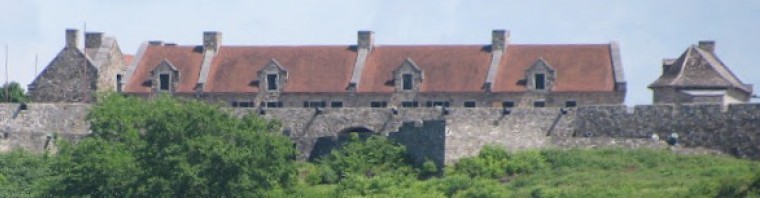
Barracks at Fort Crown Point

Barracks at Fort Crown Point

.

General Jeffrey Amherst began building the fortress in 1759. This impressive fort, when completed and garrisoned, was seven times the size of the old French fort on the site (Fort St. Frederic), and was the largest British fortress in colonial America. The main fort was pentagon shaped with bastions situated at each point. Located inside the fortress were a number of stone barracks and officer’s quarters.

Earthen ramparts faced with logs, ditches and cleared fields of fire covered about seven acres and mounted 105 cannons. The entire fortification complex, including redoubts, blockhouses and redans, covered over 3.5 square miles. Located to the East was Grenadiers Redoubt, to the South East was the Light Infantry of Regiment’s Redoubt, and to the South West was General Gages’ Redoubt.

A major fire destroyed much of the fort in April 1773. During the Revolutionary War, General Benedict Arnold made repairs and used some of the barracks. American troops occupied the Grenadier’s Redoubt and constructed another small fortification in that area.

.

Fort St. Frederic:

Strategic location of Fort Crown Point

Strategic location of Fort Crown Point

.

In 1734 France began construction of a fort at Crown Point; this was the first substantial fortification in the Champlain Valley.

From 1734-1755 France maintained complete control of the Champlain Valley. Fort St. Frederic controlled the narrows between Crown Point on what is now the New York side of Lake Champlain and Chimney Point in what is now Addison, Vermont.

Charles de Beauhamois, Governor of New France (Canada), actively encouraged settlement around Fort St. Frederic, and created a French community around the fort. This combined military and civilian presence blocked British expansion. In 1759 about 12,000 British regulars and provincial troops captured the fort. Following the French retreat from Crown Point in 1759, General Amherst embarked upon an ambitions plan to secure the area for Britain.

.

Fort Crown Point:

Fort Crown Point

Fort Crown Point

.

The British immediately began construction of “His Majesty’s Fort of Crown Point,” as well as three redoubts and a series of blockhouses and redans, all interconnected by a network of roads. The fortification complex covered over three and one-half square miles, making it one of the most ambitious military engineering projects undertaken by the British in colonial North America.

An elaborate system of fortifications was begun on the point. At times, as many as 3000 soldiers and artisans were engaged in the construction of Fort Crown Point, three smaller forts, called redoubts, several block houses, store houses, gardens and military roads. A village grew up close to the Fort wall with a tavern, store, apothecary shop, and the home of soldiers families and retired officers.

When control of Canada passed to Britain, at the end of the French and Indian War in 1763, construction ceased leaving one barracks building unfinished. Lake Champlain became a vital highway linking two diverse regions of British North America. Crown Point, located midway between Albany and Montreal, became the center of communication between New York and Canada.

In April 1773, a chimney fire spread from the soldier’s barracks on the log walls of the fort and resulted in the explosion of the powder magazine and the virtual destruction of the main fort.

Troop strength at Crown Point was gradually reduced until only a small garrison remained to surrender the fort to American rebel troops commanded by Seth Warner in May of 1775.

.

Fort Crown Point during the American Revolution:

.

At the outbreak of the American Revolution, the rebellious colonists looked to Crown Point to aid their cause.

The surrender of Fort Crown Point to American rebel troops commanded by Seth Warner in May of 1775 yielded 114 pieces of cannon and heavy ordnance sorely needed by the Americans. Colonel Henry Knox carried twenty-nine of these to Boston during that winter to force the British out of the city.

On May 23, 1775, Fort Crown Point was the meeting place for Ethan Allen, the Green Mountain Boys, Benedict Arnold and his small American Navy. Ethan Allen was returning from an attempted penetration of Canada, but was driven out by British troops. A month later, the British would take Allen prisoner in another unsuccessful attempt. Benedict Arnold and his navy would assume control of Crown Point and Lake Champlain. A month later, he would relinquish it to General Philip Schuyler’s Northern Department of the Continental Army in a dispute over control.

In the fall of 1775, Schuyler and his army embarked from Crown Point with 1,700 troops for another attempt to conquer Canada. Beaten, they returned from Quebec in June 1776, to lie in makeshift hospitals at Crown Point.

In May 1775, Seth Warner’s American Forces captured the fort and Crown Point became a springboard for an invasion of Canada. General Richard Montgomery’s force sailed down the lake in August 1775. Despite initial success in Montreal, the combined forces of Montgomery and Benedict Arnold were defeated at Quebec in December 1775. They retreated in disarray, riddled with smallpox, to Crown Point. Men died by the hundreds in makeshift field hospitals and were buried in mass graves.

In the fall of 1776, Lieutenant-Colonel Thomas Hartley and the 6th Pennsylvania Regiment heard the sounds of the naval engagement at Valcour Island from their entrenchments at Crown Point. The American Navy, once again led by Benedict Arnold, ambushed the British Naval Force, but was eventually forced to retreat down Lake Champlain. The regiment at Crown Point also retreated southward to Fort Ticonderoga and Mount Independence.

While Arnold directed the construction of a Naval Squadron in the summer of 1776. Tripps fortified Crown Point in preparation of an expected British attack. Not until Arnold’s squadron was badly beaten at the battle of Valcour Island in October did the last American troops abandon Crown Point to occupy Mount Independence overlooking Fort Ticonderoga.

Crown Point was a staging area for the British in both 1776 and 1777. After the Americans abandoned Crown Point, the British assembled their troops here. Delayed by the American Navy, Sir Guy Carleton arrived here with his troops in October of 1776, but retreated north for the winter shortly thereafter. British General John Burgoyne’s army arrived here in June of 1777. Crown Point remained under British control until the end of the war.

The last major action to involve Crown Point was Burgoyne’s expedition in 1777. As support for his advancing army, a hospital was erected, a garrison of 200 men, was left at Crown Point that summer. Despite Burgoyne’s defeat at Saratoga, the British retained absolute control of Lake Champlain with the garrison at Crown Point for the remainder of the war. Their ships cruised regularly between Crown Point and the naval shipyard at St. Jean. Crown Point did not return to American control until after the Peace Treaty in 1783.

.

South Hero Stone Castles

Stone Castles in South Hero, Vermont

South Hero Stone Castles 1

The Lake Champlain Islands are well-known for their water sports, fishing and spectacular sunsets but they have something a casual tourist (or local) might not expect… castles. In the town of South Hero stone castles are scattered throughout, but they are very small and are hard to find.

I remember driving along West Shore Road in South Hero about 25 years ago and seeing miniature castles, bird feeders, planters and fountains made of stone. I wondered why there were so many of these works of art in such a small area. Was this a local custom, or were they the work of one person?

Well, here’s the story:

A Change of Plan

Harry Barber was born in Switzerland and always had a strong fondness for the castles found throughout the country. After he was injured in a mining accident, and received a large settlement from the government in the 1920’s, he decided he wanted to travel to Chile in South America. On his way through France he was robbed, and decided he would work his way to the Americas aboard a freighter. The only one that he could find was bound for Montreal – a long way from his dream of Chile.

South Hero Stone Castles

After arriving in Montreal, he began his journey to Chile on foot, and traveled south into Vermont. When he reached Grand Isle he met a young woman selling fruit. She saw that he was hungry, and offered him an orange.

Appreciative of her kindness, Harry decided to stay in the Islands for a while. With the woman’s help, he found work as a farm hand on nearby Providence Island, just off the coast of South Hero. He continued to see the girl, and fell in love with her. They eventually married and bought a home in South Hero.

.


Harry Barber’s Passion

Harry worked at a variety of jobs, but his true passion was always the castles that he remembered from his homeland. He created miniature buildings from local Vermont field stone. He was a passionate gardener and groundskeeper, and often loved to enhance the look of his properties by constructing beautiful castles, fountains and stone walls made from local field stone. The South Hero stone castles, of course, were all modeled after the castles of his homeland. He put such craftsmanship and detail into them, that he soon developed a reputation. Soon, he worked for wealthy patrons – building his miniature castles on their lawns or near their gardens. He also built a few fountains.

South Hero Stone Castles


Harry became truly inspired by his passion of constructing these castles, and tried unsuccessfully to persuade a local museum to display some of his work. But the museum turned him down, and told him they were not interested. Devastated, he committed suicide in 1966 at the age of 66. Though his motives were unclear, some say it was due to a broken heart. He deemed himself a failure after being rejected.

.

The South Hero Stone Castles Today

South Hero Stone Castles

But Harry’s passion lives on. There are still some of these fountains and planters displayed on the lawns of several homes in South Hero. You can see examples of his passionate craftsmanship by touring the south end of South Hero, especially along West Shore Road.

Many of his original  stone castles in South Hero, along with his planters and water fountains can still be seen scattered around many lawns or properties. The exact number of structures he built, and the number of those that survive are unknown. Most are on private property, and trespassing is inappropriate;  others are hidden behind obstructions like plants. They are beautiful and unique reminders of a man with a dream and a fascinating story.

“Five castles, three houses, and several garden structures remain in the Islands. They vary in complexity. Some castles feature glazed windows, interior fireplaces, or dungeons. Others are wired for electricity and have the capability of running water in the moat. … All his creations are privately owned, and public access is not permitted; however four out of the five castles can be seen from the road.”   –  From a brochure issued by the Lake Champlain Bikeways.

South Hero Stone Castles


Custom Lake House Champlain Sign
Custom Lake House Champlain Sign – Rustic Hand Made Vintage Wooden Sign 11.25 x 60 Inches!!
High-quality materials will make this sign last for years. 100% USA Materials.
Truly a one of a kind gift.
Order Here


Other Articles About Lake Champlain Islands:   List of Lake Champlain's Islands